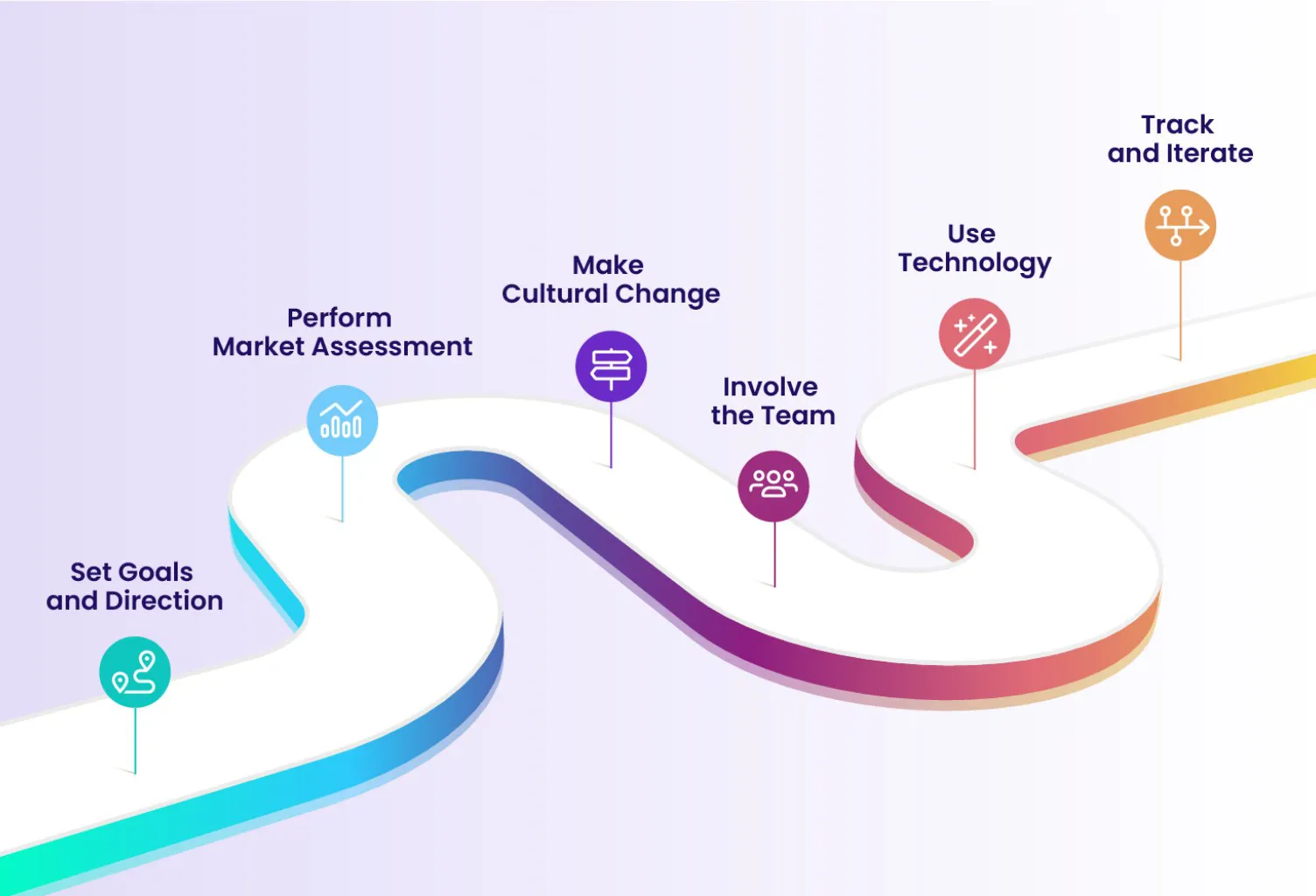
Digital transformation for traditional businesses modernizing legacy systems represents the most critical strategic initiative organizations face in 2025. Legacy systems no longer serve as stable operational foundations—they have become liabilities accumulating technical debt, constraining innovation capacity, and creating escalating security vulnerabilities that threaten organizational competitiveness. The business case for modernization is compelling: organizations achieving systematic modernization realize 15-35% annual infrastructure cost reduction, 30-50% operational efficiency gains, and measurable revenue acceleration through faster market responsiveness. Yet successful modernization transcends technology decisions—it requires orchestrated change across organizational culture, operating models, skill development, and business processes.
This roadmap addresses the fundamental challenge traditional enterprises face: how to systematically transition from legacy monolithic architectures to cloud-native, microservices-based platforms while maintaining business continuity and managing organizational resistance. The answer combines proven cloud migration frameworks (the 6 Rs), phased implementation approaches reducing risk, comprehensive organizational change management addressing cultural barriers, and continuous modernization practices preventing re-accumulation of technical debt. Organizations following this structured approach dramatically improve transformation success rates, reduce implementation costs by 20-40% compared to ad-hoc approaches, and achieve faster return on investment through early quick wins funding subsequent phases.
The Legacy System Challenge
Traditional businesses often operate with enterprise systems deployed 15-20 years ago when cloud computing, microservices, containerization, and AI-driven automation did not exist. These monolithic architectures—typically consisting of tightly coupled frontend, middleware, and database layers with shared resources—increasingly constrain organizational capability in ways executives and boards fail to recognize until crisis forces action.
The hidden costs of legacy systems escalate annually. Legacy infrastructure requires specialized knowledge held by senior engineers whose expertise becomes increasingly irreplaceable. When these engineers depart, organizations face critical skill gaps threatening system reliability. Legacy code typically lacks modern security frameworks, becoming increasingly vulnerable to evolving cyber threats. Each patch or update carries disproportionate risk requiring extensive testing to prevent failures disrupting business operations. Integration with modern applications proves technically difficult and costly, forcing workarounds that further compound technical debt. Innovation becomes paralyzed as development teams spend 60-70% of effort maintaining legacy systems rather than building competitive capabilities.
Meanwhile, competitive threats intensify. Digital-native competitors unburdened by legacy infrastructure deploy new capabilities in weeks, while traditional enterprises require months to navigate legacy system constraints. Customer experience expectations accelerate—real-time personalization, mobile-first interfaces, and omnichannel integration are no longer differentiators but baseline requirements. Yet legacy systems often struggle with these capabilities, forcing organizations to build expensive shadow IT solutions that fragment systems further.
The financial reality is stark: organizations continuing legacy system dependence face escalating maintenance costs, diminished competitive positioning, and amplified security vulnerabilities compounding annually. The alternative—systematic modernization—demands significant upfront investment, organizational disruption, and executive courage. Yet the data conclusively demonstrates that modernization delivers superior financial outcomes, accelerated time-to-market, and competitive advantages positioning enterprises for sustained success.
Understanding Technical Debt
Before initiating modernization, organizations must understand and quantify technical debt—the accumulated cost of suboptimal architectural decisions, code quality shortcuts, and deferred maintenance. Technical debt functions like financial debt with exponentially increasing interest rates. Every day of delay increases future remediation costs, creating a compounding liability that compounds faster than most organizations can address through incremental improvement.
Technical debt takes multiple forms. Deliberate technical debt represents conscious trade-offs where organizations prioritized speed-to-market over architectural perfection, knowing future refactoring would be required. Accidental technical debt accumulates organically through organic growth, inconsistent standards, knowledge gaps, and the natural aging of systems designed without anticipating future requirements.
Measuring technical debt requires quantitative frameworks preventing subjective decision-making. The technical debt ratio (TDR) measures remediation costs against original development costs, with TDR under 5% considered healthy. Code complexity metrics including cyclomatic complexity and cognitive complexity quantify how difficult code is to understand and modify, directly correlating with maintenance costs and defect rates. Defects per line of code and customer-reported issue rates provide direct insights into system fragility. Test coverage percentages reveal code segments lacking automated validation, indicating vulnerability to future regressions.
Organizations typically underestimate technical debt severity until measurement exercises reveal the comprehensive scope. A financial services organization recently discovered their legacy core system required approximately 7,000 hours annually to maintain—equivalent to 3-4 full-time engineers dedicated exclusively to preventing system degradation without adding new capability. When quantified this way, the business case for modernization becomes undeniable to finance and executive teams.
The 6 Rs: Modernization Strategy Framework
Successful modernization avoids the “one-size-fits-all” approach, recognizing that different applications require different strategies based on business value, technical complexity, and strategic importance. The 6 Rs framework provides a proven decision-making structure ensuring each legacy application receives the appropriate modernization approach. Different applications progress through different Rs, with organizations typically employing multiple strategies across their portfolio.
Rehosting (Lift-and-Shift) represents the fastest, lowest-risk path to cloud migration, moving applications to cloud environments with minimal code changes. Organizations achieve approximately 30% cost savings through cloud infrastructure optimization and elimination of dedicated server maintenance. Rehosting particularly suits applications that are operationally stable, business-critical but not requiring architectural redesign, and where rapid migration delivers business value through infrastructure cost reduction. Companies like GE Oil & Gas demonstrated this approach, achieving rapid cost savings by rehosting without implementing cloud-native optimizations. The primary trade-off is foregoing additional cloud-native benefits available through deeper modernization, limiting long-term cost savings to approximately 30% versus 60-70% achievable through comprehensive refactoring.
Replatforming (Lift-Tinker-and-Shift) makes targeted modifications to leverage cloud platform capabilities while maintaining core architecture intact. Typical modifications include migrating databases to managed cloud services (like Amazon RDS or Azure SQL Database), eliminating dedicated database administration overhead; switching application servers to cloud-native alternatives; or implementing container orchestration without complete rewrite. Replatforming realizes approximately 50% cost savings through more extensive cloud optimization than rehosting while requiring significantly less effort than complete refactoring. This strategy particularly suits applications where database optimization or managed service benefits provide substantial value but where core application logic remains sound.
Refactoring (Re-architecting) represents the most comprehensive modernization approach, redesigning applications as cloud-native microservices, decomposing monoliths into independently deployable services, implementing containerization and orchestration platforms like Kubernetes, and leveraging advanced cloud services including serverless computing and managed AI platforms. Refactoring delivers 60-70% cost savings through extensive cloud-native optimization but requires 6-18 months of development effort and carries higher implementation risk. This approach particularly suits business-critical applications where competitive advantage depends on rapid feature development, where scalability requirements demand elastic architecture, or where the application represents core strategic capability requiring competitive differentiation. The financial payoff typically justifies investment through accelerated development velocity, reduced operational overhead, and improved system resilience enabling faster recovery from failures.
Repurchasing (Replace) evaluates whether replacing a legacy application with cloud-based SaaS solutions delivers better value than modernizing in-place. Modern SaaS platforms increasingly provide functionality matching or exceeding legacy in-house systems while offering superior user experience, continuous updates including security patches, and reduced operational burden. Organizations increasingly pursue repurchasing for non-strategic systems including HR platforms, financial management, collaboration tools, and content management, reserving in-house development capacity for strategic capabilities providing competitive differentiation. The challenge emerges when legacy systems embed business logic reflecting decades of operational optimization, making SaaS replacement require significant process redesign. Cost-benefit analysis must account for both technical implementation and business process change management expenses.
Retiring applications that have become obsolete or redundant eliminates ongoing maintenance costs and complexity. Organizations often discover that competitive features and capabilities now provided by modern platforms eliminated the need for maintaining specialized legacy applications. Rather than continuously modernizing deprecated applications, strategic organizations identify retirement candidates and consolidate capability into modern platforms, simplifying the overall IT ecosystem while reducing maintenance burden. Retirement typically receives insufficient attention during modernization planning, as managers resist acknowledging investment sunk into systems now ready for deprecation.
Retaining applications running on-premises or legacy infrastructure recognizes that not all systems require cloud migration. Certain workloads—highly specialized systems with limited scalability requirements, applications with stringent data residency or governance constraints, or stable systems with minimal change frequency—may remain on-premises longer than others without competitive disadvantage. The key is conscious decision-making regarding retention rather than defaulting to on-premises deployment due to organizational inertia. Retain decisions should be revisited periodically as cloud technology capabilities advance and business requirements evolve.
Modernization Roadmap: Three-Phase Transformation Model
Successfully implementing digital transformation requires orchestrating change across technology, organization, culture, and business processes through phased execution reducing risk and enabling course correction based on early learnings. McKinsey research and proven organizational transformations establish a three-phase model progressing from value definition through acceleration to enterprise-wide scaling.
Phase 1: Define Value & Assessment (Months 1-6) establishes the strategic foundation for transformation. Executive commitment emerges as the single most critical success factor—without visible senior leadership support and personal investment in transformation, organizational resistance will undermine implementation regardless of technical excellence. This phase begins with securing CEO/Board commitment through clear articulation of business imperative (competitive threat, cost escalation, regulatory pressure, customer experience requirements) and envisioning the competitive advantage modernization delivers.
Strategic objectives must be specific and ambitious rather than generic platitudes. Rather than “modernize legacy systems,” explicit objectives might include “reduce order processing cycle time from 48 hours to 4 hours,” “enable new customer segments through mobile-first digital experience,” or “reduce infrastructure costs by 25% while improving system reliability.” Specific objectives enable measurement, align organizational energy, and guide resource prioritization when trade-offs emerge.
Comprehensive assessment catalogs existing infrastructure, identifies technical debt, documents business process constraints, and articulates capability gaps preventing competitive response. This assessment should engage business stakeholders identifying which capabilities would drive competitive advantage if modernization enabled them. Rather than purely technical assessment, strategic assessment bridges technology and business strategy, ensuring modernization investments align with core business priorities.
Clear KPIs established during Phase 1 guide decision-making throughout transformation. Rather than purely technical metrics (response times, deployment frequency), leading organizations establish business metrics including revenue growth acceleration, market response time, customer satisfaction improvement, and employee productivity gains. Baseline measurements during Phase 1 enable quantifying transformation impact post-implementation.
Phase 2: Launch & Acceleration (Months 7-18) translates strategy into demonstrable results through pilot projects generating early momentum. Rather than attempting comprehensive enterprise-wide transformation simultaneously, strategic organizations initiate 2-3 lighthouse projects selecting applications combining business value, achievable technical scope, and high organizational visibility. Successful lighthouse projects demonstrate competence, build organizational confidence, refine implementation approaches, and generate funding from demonstrated returns accelerating subsequent initiatives.
This phase establishes the operating model and organizational structure supporting modernization. Cross-functional teams combining development, operations, business stakeholders, and change management resources replace traditional departmental silos. DevOps practices including continuous integration/continuous deployment (CI/CD) pipelines reduce deployment cycle times from months to days or hours, enabling rapid iteration and faster value realization. Importantly, this phase explicitly addresses organizational culture and ways of working, as technical modernization falters when organizational structures and processes remain unchanged.
Employee training and capability development prove essential but frequently receive insufficient investment. Legacy systems typically employed specialists with deep but narrow expertise in aging technologies. Modern cloud platforms require distributed capability—team members understanding cloud architectures, containerization, microservices patterns, infrastructure-as-code, and continuous deployment practices. Organizations must invest heavily in training programs, hiring to fill capability gaps, and creating psychological safety enabling team members to experiment with unfamiliar technologies.
Organizational change management represents Phase 2’s most underestimated challenge. Technical implementation typically proceeds on schedule; organizational adaptation consistently lags timelines. Transparent communication addressing “why” transformation is necessary, “how” organizations will transition, and “what” individual roles will change proves essential. Middle management particularly requires engagement and empowerment, as these leaders translate executive vision into ground-level implementation.
Phase 3: Scaling & Optimization (Months 19-36) extends successful patterns across the enterprise, completing major system migrations and establishing the modernized operating model as standard practice. Rather than sequential application-by-application migration, strategic organizations sequence initiatives balancing quick wins with long-term strategic objectives. High-impact, lower-complexity applications deliver early ROI funding continued transformation. Critical but complex applications receive dedicated resources and extended timelines ensuring successful implementation of foundational systems.
Performance optimization accelerates during Phase 3 as organizations transition from “get to cloud” to “optimize in cloud.” Many organizations rehosting applications in Phase 2 begin replatforming in Phase 3, implementing managed services and cloud-native architectures realizing incremental cost savings. Advanced capabilities including AI/ML integration, real-time analytics, and automated decision systems become feasible once foundational modernization completes.
This phase establishes sustainable operating models preventing re-accumulation of technical debt. Continuous integration/continuous deployment capabilities become standard for all teams. Architecture governance frameworks establish standards preventing inconsistent technical decisions fragmenting the environment. Dedicated capacity for technical debt remediation (typically 10-20% of development time) prevents the debt from reaccumulating post-modernization.
Organizational and Cultural Transformation
Modernization roadmaps emphasizing technology while neglecting organizational change consistently fail. Research conclusively demonstrates that organizational culture, leadership commitment, and change management capability determine transformation success more than technical platform selection. A sophisticated cloud architecture deployed without organizational capability and cultural readiness delivers disappointing results, while simpler technical approaches implemented by aligned, motivated teams achieve superior outcomes.
Leadership emerges as the critical success factor. Visionary leaders modeling digital behaviors and actively supporting innovation drive transformation success. Conversely, leaders clinging to historical decision-making or viewing modernization as IT initiative rather than business strategy undermine organizational commitment. Effective transformation leadership requires visible commitment—CEOs allocating board time to transformation progress, dedicating senior leaders to oversee implementation, publicly celebrating early wins, and personally addressing organizational resistance.
Organizational culture fundamentally determines transformation receptiveness. Culture emphasizing adaptability, collaboration, innovation, and experimentation accelerates transformation. Conversely, risk-averse cultures resisting change, departmental silos prioritizing local optimization over enterprise benefit, and fear of failure paralyze modernization initiatives. Changing culture requires sustained effort—symbolic leadership actions (executives learning new technologies, celebrating productive failures, publicly acknowledging outdated practices), process changes reinforcing desired behaviors, performance metrics rewarding collaboration and innovation, and psychological safety enabling team members to experiment without fear of punishment for unsuccessful attempts.
Change management strategies must address resistance patterns. Resistance typically emerges from multiple sources: employees fearful that modernization eliminates their specialized legacy expertise; managers concerned about authority reduction as flat agile teams replace hierarchical structures; middle management skeptical whether modernization delivers promised benefits; and operational teams accustomed to stability viewing change as disruptive. Rather than dismissing resistance, effective change management acknowledges concerns, engages skeptics in problem-solving, and demonstrates through pilot project results that modernization delivers benefits worth temporary disruption.
Communication represents a critical change management lever. Over-communication leads to message fatigue; under-communication generates speculation and resistance. Strategic organizations establish targeted communication cadences—regular all-hands updates addressing “why” modernization matters and demonstrating progress; department-specific communications addressing implications for particular functions; and one-on-one conversations addressing individual concerns. Importantly, communication must be bi-directional—listening to employee concerns and incorporating feedback demonstrates respect and builds trust.
Incentive alignment ensures behaviors supporting transformation goals. Individual performance metrics should reflect transformation contributions alongside traditional productivity measures. Promotion decisions should favor leaders championing modernization and building team capabilities. Compensation should reward successful pilots and rapid deployment cycles, not punish reasonable failures as teams learn unfamiliar technologies. When incentives misalign—rewarding stability and risk-aversion while claiming to pursue transformation—organizational skepticism dominates.
Technology Stack Selection for Modern Architecture
Modernization demands thoughtful technology stack decisions—the combination of programming languages, frameworks, databases, infrastructure platforms, and operational tooling supporting applications. Rather than defaulting to historically-used technologies, modernization offers opportunity to select technology stacks optimizing for contemporary business requirements and operational practices.
Business requirements drive technology stack decisions, not technology trends. Before evaluating specific technologies, organizations must define what problems require solving. Does the application require real-time responsiveness serving millions of concurrent users? Does it integrate with legacy systems requiring specific API compatibility? Must it comply with data residency regulations constraining deployment geography? Does competitive advantage depend on rapid feature development enabling frequent releases? Different business requirements demand different technology stacks.
Scalability and maintainability requirements fundamentally shape architecture. Monolithic applications bundling all functionality into single deployable units limit independent scaling—if one component requires scaling due to demand increase, the entire application must be scaled, wasting resources on scaling underutilized components. Microservices architectures decompose applications into independent services scaling separately based on individual demand patterns, dramatically improving resource efficiency and cost optimization. Containerization with platforms like Docker enables consistent deployment across development, testing, and production environments, eliminating “works on my machine” problems and enabling standardized operational practices.
Cloud-native technology stack patterns have emerged as industry best practices. Frontend applications typically employ modern JavaScript frameworks (React, Vue, Angular) providing responsive user experiences. Backend services leverage cloud-native languages including Node.js, Python, Go, or Java, with selection depending on performance requirements, team expertise, and ecosystem maturity. Databases demonstrate increasing polyglot approaches—relational databases (PostgreSQL, MySQL) remain optimal for transactional data requiring ACID guarantees; NoSQL databases (MongoDB, Cassandra) excel with unstructured or rapidly evolving schemas; cache layers (Redis) accelerate high-performance queries. Infrastructure-as-code and containerization enable reproducible deployments. CI/CD pipelines automate testing and deployment, enabling continuous delivery reducing time-to-market.
Emerging technology integration increasingly requires explicit architecture decisions. AI/ML capabilities increasingly provide competitive advantage through predictive analytics, automated decision-making, and intelligent recommendations. Organizations should evaluate ML frameworks (TensorFlow, PyTorch) for training capabilities and model serving infrastructure (ML-Ops platforms, inference engines) supporting production deployment. Edge computing capabilities enable processing at network edges improving latency and resilience. Event-driven architectures using streaming platforms enable real-time data processing and event-driven workflows.
Team expertise fundamentally constrains technology stack selection. The most technically optimal stack becomes a liability if no qualified developers can maintain it. Organizations should balance innovation goals with team capability, prioritizing hire-ability and market availability of required expertise. The best approach typically combines proven technologies where team expertise exists with limited introduction of new technologies where competitive advantage justifies capability development.
Financial Business Case and ROI
Quantifying modernization ROI requires measuring both hard financial benefits and softer strategic value. Hard benefits—direct cost reduction and revenue acceleration—provide compelling financial justification. Soft benefits—improved security posture, regulatory compliance capability, employee satisfaction, and organizational agility—provide strategic value more difficult to quantify but increasingly recognized by sophisticated executives as essential competitive capabilities.
Infrastructure cost reduction represents the most predictable benefit. Modernized organizations typically achieve 15-35% annual infrastructure cost reduction through cloud platform optimization, elimination of dedicated hardware maintenance, and improved resource utilization. Cloud platforms charge for actual resource consumption, eliminating the over-provisioning inherent in on-premises infrastructure where organizations maintain capacity to handle peak demand but only consume fraction of that capacity during normal operations. Organizations utilizing Azure achieved 228% return on investment over three years through Azure PaaS adoption, with payback in approximately 18 months.
Operational efficiency gains compound over time. Modernized systems require less specialized knowledge, enabling career advancement from “legacy maintainers” to “innovation builders.” Automated deployment pipelines reduce deployment cycle times from months to days or hours, enabling faster bug fixes and security patches. Automated monitoring and alerting reduce mean time to resolution for incidents, improving system reliability and reducing firefighting. Organizations report 30% IT operations productivity improvement through automation and modernization. A financial services organization implementing modernization achieved 40% reduction in IT support costs within one year of completing legacy modernization.
Revenue acceleration through faster market response time represents perhaps the most strategically significant benefit. Digital-native competitors deploying new capabilities in weeks force legacy-encumbered enterprises to respond through rapid innovation or face market share loss. Modernized architecture enabling continuous delivery reduces feature development cycle times by 50%+ compared to legacy constraints, enabling organizations to respond faster to market opportunities and competitive threats. Manufacturing organizations modernizing supply chain systems achieved 60% faster order processing, 35% infrastructure cost reduction, and real-time visibility enabling seamless partner integration.
Improved customer experience drives revenue growth and retention. Modern architecture enables personalization, real-time responsiveness, and seamless omnichannel integration that legacy systems cannot provide. Organizations improving customer satisfaction metrics through modernized digital experience consistently achieve revenue uplift—financial services organizations report 5-10% overall revenue uplift through modernized core systems; retail organizations achieve improved customer lifetime value through superior experience.
Cost payback timelines reward systematic modernization. Infrastructure consolidation typically delivers 6-12 month initial cost savings. Operational efficiency gains accelerate cash flow by months 8-12. Maintenance cost elimination provides predictable monthly reductions. Productivity improvements and revenue acceleration compound returns beyond 18-month mark. Organizations using TCO analysis demonstrate that modernization typically achieves payback within 18-24 months, with positive cash flow continuing indefinitely as organizations avoid legacy system escalating maintenance costs.
Managing Technical Debt Continuously
A critical insight from modernization practitioners is that technical debt doesn’t end with modernization—it simply evolves as new technical decisions compound over time. Organizations treating modernization as one-time project often find themselves re-accumulating technical debt within 5-7 years, necessitating another expensive modernization cycle. Successful organizations adopt continuous modernization mindset, treating technical debt management as ongoing organizational practice rather than periodic crisis response.
Automation represents the power tool for technical debt management. Manual identification and remediation of technical debt is time-consuming and error-prone. Modern AI-assisted code review tools (GitHub Copilot, CodeQL) automatically identify potential issues, suggest improvements, and enforce best practices at development time, preventing debt from accumulating in the first place. Software mapping tools using machine learning analyze application dependency graphs, identifying problematic patterns and complexity risks. Generative AI models can analyze code and documentation, identify technical debt patterns, and even suggest or generate remediation code.
Governance and standards prevent debt reaccumulation. Architecture governance frameworks establish consistent design patterns, approved technology stacks, and coding standards that development teams must follow. Rather than viewing governance as bureaucratic obstacle, sophisticated organizations design governance enabling fast development while preventing inconsistent decisions fragmenting the environment. Self-service platforms providing pre-built templates, infrastructure-as-code examples, and approved deployment patterns accelerate development while maintaining architectural consistency.
Dedicated budget and capacity allocation for technical debt remediation proves essential. Leading organizations allocate 15% of IT budget specifically to technical debt management, dedicating 10-20% of each development sprint to debt reduction activities. When technical debt remediation competes with feature development for the same development capacity, features consistently win—engineers prefer building new functionality to cleaning up code, and product managers demand new features over invisible debt reduction. Formal allocation ensures debt reduction receives consistent attention preventing accumulation.
Implementation Success Factors
The distinction between modernization initiatives succeeding and those faltering often traces to seemingly “soft” organizational and execution factors rather than technical platform selection.
Executive sponsorship and governance must go beyond initial commitment. Successful organizations establish modernization steering committees including C-suite executives meeting regularly to review progress, address obstacles, and maintain organizational priority for transformation amidst competing initiatives demanding executive attention. Clear governance decision-making frameworks prevent endless debate about technical approaches, enabling decisive progress.
Phased implementation reducing risk proves superior to attempting comprehensive transformation simultaneously. Rather than migrating all applications to cloud within 12 months (a common but unrealistic goal), phased approaches sequence initiatives 6-18 months per phase, enabling organization learning, course correction, and demonstrating progress that builds organizational confidence and funding for subsequent phases.
Early quick wins generating momentum disproportionately impact subsequent success. Successful organizations select pilot projects combining business value, achievable technical scope, and high organizational visibility, demonstrating that modernization delivers promised benefits. These wins generate organizational support, attract talent to modernization initiatives, and provide evidence justifying resource allocation to more complex subsequent projects.
Investment in team capability and talent receives insufficient executive emphasis despite being critical success determinant. Modernization demands skills including cloud architecture, DevOps practices, containerization, microservices design patterns, and modern development methodologies. Organizations must either hire new talent or invest heavily in existing team training. Cost-benefit analysis must account for both direct training expenses and productivity impact as teams learn unfamiliar technologies.
Clear communication addressing organizational concerns dramatically influences adoption success. Transparent communication about why modernization is necessary, how the organization will progress, and what individual roles will change builds trust and reduces resistance. Importantly, communication should acknowledge legitimate concerns (job security, learning curves, temporary disruption) while demonstrating that modernization benefits justify short-term costs.
Strategic Outlook: Continuous Transformation
Organizations completing modernization initiatives often treat completion as endpoint—milestone achieved, now return to business as usual. This mindset creates vulnerability as technology continues advancing rapidly and competitive threats emerge. Digital transformation represents continuous organizational practice rather than one-time project. Technologies including AI/ML, edge computing, blockchain, and advanced analytics will continue disrupting competitive advantages, requiring organizations to maintain constant learning and adaptation capability.
The most successful enterprises cultivate transformation competence as organizational capability. Rather than viewing modernization initiatives as episodic projects managed by specialized teams, leading organizations embed digital transformation into their operating model, treating continuous technology evaluation and adoption as standard management practice. This requires culture emphasizing innovation and experimentation, governance frameworks enabling rapid evaluation of emerging technologies, and investment in team learning and capability development supporting continuous evolution.
Traditional businesses successfully modernizing legacy systems gain competitive advantage not just from modernized infrastructure but from organizational transformation enabling future adaptation. The ability to rapidly evaluate emerging technologies, experiment with new approaches, and scale successful innovations becomes core competitive capability in increasingly digital economy.